



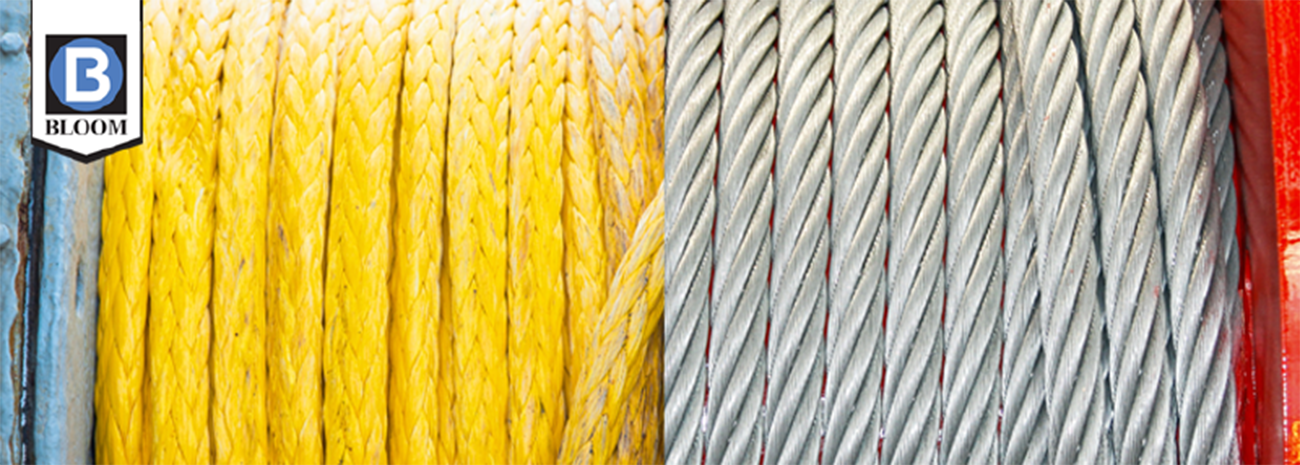
Selecting the right winch rope is more than simply a matter of preference. The rope you choose directly impacts safety, handling, durability, and the overall performance of your equipment. When you understand how synthetic and wire rope winches differ, you can make the best choice for your company and the safety of your crew. This guide gives you a clear breakdown of the similarities and differences, so you know which one is right for your next project.
Understanding the Core Differences
Synthetic rope and wire rope serve the same purpose but behave very differently during operation. Their contrasting properties influence how they perform in real-world conditions, from job sites to recovery operations.
Weight & Handling
One of the core differences between these two is the rope itself. Synthetic rope is significantly lighter than its wire counterpart, making it easier to pull, guide, and spool. By contrast, the heavier and more rigid wire rope is more durable and can handle heavier loads, but at the expense of requiring more effort to operate safely and effectively.
If your work involves frequent winching or repositioning, the reduced strain of a synthetic line can offer a noticeable advantage. For more stationary, heavy-duty applications, the sturdiness of wire rope may be more suitable.
Strength & Load Performance
Both rope types can achieve comparable breaking strengths, but the difference lies in how they carry that strength. Synthetic rope excels in strength-to-weight efficiency. Its pliability allows it to distribute the payload evenly. Wire rope, on the other hand, holds up well under direct, heavy loads and maintains shape during repeated lifting or pulling cycles.
For high-frequency, heavy-duty industrial tasks where consistency matters, wire rope offers predictable performance. For vehicle recovery and marine use, strength with lower mass gives synthetic rope the clear advantage.
Durability in Real-World Environments
Environmental exposure plays a critical role in rope longevity. Each material handles weather and abrasion differently.
Abrasion & Surface Contact
- Synthetic rope is more vulnerable to sharp surfaces, rocks, and debris.
- Wire rope withstands abrasion far better due to its steel composition.
If your winching application frequently involves rugged terrain or metal-on-metal contact, you’re likely looking for the resilience of a wire rope.
Weather & UV Exposure
- Synthetic rope resists corrosion, making it ideal for saltwater and moisture-heavy environments. UV exposure, however, can degrade fibers over time.
- Wire rope resists UV damage completely but can corrode when exposed to moisture without proper lubrication.
This makes synthetic a strong choice for marine and humid environments, while wire rope is preferred in sun-exposed industrial settings.
Safety Considerations
Safety is one of the most important factors in winch rope selection. Failure happens, and it’s important to know how your equipment responds to failure so you can protect yourself and your crew. Synthetic rope falls to the ground when it breaks, which reduces recoil risk, whereas wire rope stores far more kinetic energy, causing it to snap back with potentially dangerous force when it breaks.
For operators who prioritize safety — especially in close-proximity scenarios — synthetic rope offers a significant advantage.
Handling Requirements
- Synthetic rope is comfortable to hold and does not develop steel burrs.
- Wire ropes require gloves to protect hands from broken strands and sharp edges.
These handling differences matter most during frequent spooling and field adjustments.
Maintenance & Lifecycle Expectations
Maintenance demands vary widely between these two rope materials.
Synthetic Rope Maintenance
- Requires frequent inspection for fraying
- Should be cleaned of sand, dirt, or mud
- Needs protection from direct heat sources
Wire Rope Maintenance
- Needs periodic lubrication
- Must be monitored for rust or internal corrosion
- Can develop burrs or kinks that compromise performance
Understanding the time you have to dedicate towards maintenance and the environment you’re working in helps determine which rope makes the best choice for your operations.
Choosing the Right Rope for Your Application
Choose Synthetic Rope If You Need:
- Lightweight handling
- Increased operator safety
- Corrosion resistance
- Better performance in marine or wet environments
Ideal applications: Off-road recovery, ATVs, marine equipment, and applications where weight and safety matter most.
Choose Wire Rope If You Need:
- High abrasion resistance
- Durability in industrial and construction environments
- Resistance to UV exposure
- Long service life under heavy use
Ideal applications: Construction equipment, utility vehicles, heavy-duty lifting, and rugged industrial applications.
Performance Snapshot
|
Performance Factor |
Synthetic Rope |
Wire Rope |
|
Weight |
Very lightweight |
Heavy |
|
Safety |
Minimal recoil |
High recoil risk |
|
Durability |
Sensitive to heat and abrasion |
Highly abrasion-resistant |
|
Weather Resistance |
Corrosion-proof but UV sensitive |
UV-proof but prone to rust |
|
Handling |
Easy, ergonomic |
Requires safety gloves |
|
Maintenance |
Frequent inspection |
Lubrication and corrosion monitoring |
Confidence in the Right Choice
Both rope types deliver value when matched with the right task. By understanding their strengths and limitations, you can confidently choose a winch system that meets your operational demands.
If you’re still weighing your options or need guidance for a specific application, the Bloom Manufacturing team is here to help you find the best-fit solution for your equipment and environment.
January 1, 2026 by Bloom Manufacturing