



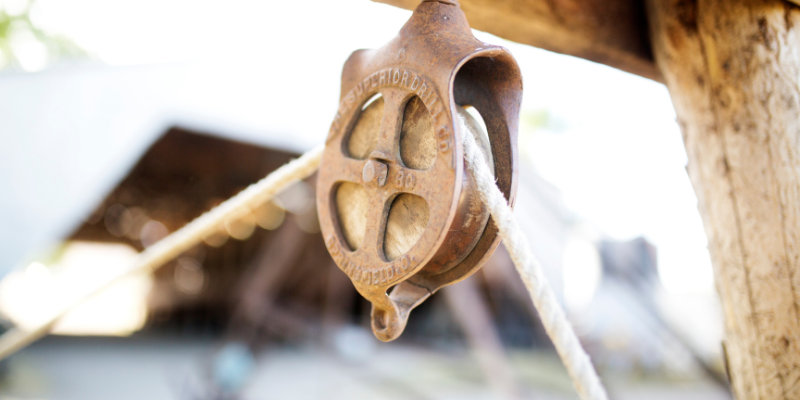
Both pulley blocks and snatch blocks are fantastic tools to help assist in facilitating your lifting operations. They both are actually considered pulley blocks. There really isn’t a right answer over which one you should choose for a specific task. Often people choose their personal preference, most of the time being what they are most familiar with. Take a few minutes to learn the true difference between a pulley block and a snatch block. If you have questions, please contact the team at Bloom Manufacturing.
What is a Pulley Block?
Pulley and Snatch Blocks can help lift up to 30 tons with their wheel on axle design. A pulley block gives direction to the rope while it’s loaded. You then can increase the line or lift the weight of a hoist or winch by multiplying lines. The noticeable trait of a pulley block is that it is always closed, so you must thread the line through the axle. Any wired rope that is rigged into the system will need to be reeved to continue on.
What is a Snatch Block?
A snatch block is very similar to a pulley block with the same wheel on axle design, however a snatch block, unlike the pulley block, is designed to open. A snatch block must open with a gate on the side to allow the wire rope to fit easily. The heavy-duty pulley is inside the forged steel casing and will run on roller bearings for friction-free use.
How Snatch Blocks and Pulley Blocks Are Used
Snatch and pulley blocks can be used interchangeably. Again, most of the time the deciding factor comes down to the user’s preference. Here are a few common uses of snatch and pulley blocks and who typically uses them:
-
On cell towers with gin poles
-
Improving the winch system
-
Mechanics and machinists may use for lifting a motor, vehicle, etc.
-
4x4 roaders
-
Arborists
-
First responders may use to recover a vehicle or lift an extreme weight
-
Lifting and/or dragging tree limbs
-
Towing vehicles
-
Recovering vehicles
-
Off-roaders
While pulley blocks and snatch blocks share many similarities, the difference ultimately comes down to how the equipment is rigged and how much flexibility the application requires. Pulley blocks offer a closed, secure setup ideal for controlled lifting and consistent configurations, while snatch blocks provide the convenience and adaptability needed when lines must be redirected or adjusted quickly in the field.
There isn’t a single “right” choice for every job. The best option depends on load requirements, rigging constraints, and how frequently the setup needs to change. When used properly, both pulley blocks and snatch blocks are proven tools that improve efficiency, control, and safety across a wide range of lifting and pulling operations. Understanding their strengths allows operators to select the right equipment with confidence and get the most out of their rigging systems.
If you’re unsure which solution is best for your application, working with an experienced manufacturer like Bloom Manufacturing can help ensure the right fit for both performance and safety.
Pulley Block vs. Snatch Block FAQs
+What is the difference between a pulley block and a snatch block?
Both pulley blocks and snatch blocks use a wheel-and-axle design to redirect or multiply force. The main difference is access. A pulley block is fully enclosed and requires the line to be threaded through the sheave, while a snatch block opens on the side, allowing the rope or cable to be inserted without disconnecting the load.
+When should I use a snatch block instead of a pulley block?
Snatch blocks are ideal when rigging needs to be changed quickly or when you cannot remove the line from the system. This makes them especially useful for vehicle recovery, arborist work, utilities, and emergency response applications.
+Do pulley blocks and snatch blocks increase pulling or lifting capacity?
Yes. When rigged correctly, both can increase mechanical advantage by distributing the load across multiple line segments. This helps reduce strain on the winch or hoist and allows heavier loads to be moved more safely and efficiently.
+Are snatch blocks and pulley blocks interchangeable?
In many applications, they can be used interchangeably. However, factors such as load rating, line type, frequency of re-rigging, and job-site conditions should determine which option is best for the task.
+Can snatch blocks be used with wire rope or synthetic rope?
Most industrial snatch blocks are designed for wire rope and compatible synthetic lines. It’s important to match the sheave size and groove profile to the rope being used to prevent excessive wear or damage.
+What industries commonly use pulley blocks and snatch blocks?
These tools are widely used in construction, utilities, tower work, towing and recovery, arborist operations, manufacturing, machining, off-road applications, and emergency response.
+Is one option safer than the other?
Both are safe when properly rated and used correctly. Safety depends more on correct load calculations, proper alignment, and choosing the right block for the application rather than the block type itself.